
Who Pays for Tennessee’s Hemp Tax Swap
A $6 state tax on a $10 package. Stores charging a tax that no longer existed. 6,500 jobs and 95 counties. Part 3 follows Tennessee’s hemp tax swap past the state ledger to the people who carry the cost.
By Shannen Sharpe
This is Part 3 of a 3-part series on Tennessee’s hemp tax. Part 1 tracked the money. Part 2 told how the law was made. This part follows the cost past the state ledger, to the people who carry it.
Tennessee’s new hemp tax can take $6 of every $10. That is the tax on the strongest package of gummies the state allows.
That package holds 300 milligrams, the most the state allows in an edible, and the wholesale tax runs 2 cents per milligram. Hemp Law Group Compliance Director Clint Palmer says a package that size can cost $10 from the distributor. That is 60% of the price, before the store adds a penny.
Lawmakers knew the rates were steep when they set them. On April 10, 2025, presenting the new tax to the House before the vote that created it, Rep. Ryan Williams, R-Cookeville, told members the rates were “the highest of most states that are currently regulating this.”
Part 1 counted what the tax collects for the state: about 2 cents of every dollar it budgeted. This part follows everyone else’s bill.
The tax that stores kept collecting
For 2 and a half years, hemp products in Tennessee carried an extra 6% tax at the register, on top of the regular sales tax. Stores collected it from customers and sent it to the state. The new law ended that tax on Jan. 1. The Department of Revenue confirmed the repeal in its published guidance. But no one told the stores directly.
Businesses that had kept collecting the tax in January tried to pay it to the state in February. By the account of Hemp Law Group Compliance Director Clint Palmer, the hemp line was simply gone from the tax return, and no one had told the license holders who had been filing it. Some Tennessee stores were still charging customers the repealed 6% tax as late as March.
In early March, Palmer and Litson Government Relations Director Kelley Hess met with a House lawmaker and 2 Department of Revenue staff members, its legislative liaison and an attorney. They asked what notice had gone out. The department’s legal staff said the change had been sent to everyone. When asked for clarification, they said that meant subscribers to Revenue’s email newsletter. That list did not include the thousands of license holders on the Department of Agriculture’s rolls.
The money stores collected with nowhere to send it ended up in the state’s general fund. For 2 and a half years, every dollar of the 6% tax had been set aside. It went into a special account, split evenly between the Department of Revenue and the Department of Agriculture, “to be used exclusively for the regulation of” hemp products. The tax paid for the system that policed it. The tax that replaced it now sends 80% of its money to the general fund.
The first 6 months of 2026 ran in 2 directions at once. Most sellers were still operating on their old licenses, so almost no one owed the new tax, and the state collected almost nothing. Meanwhile, some customers were still paying a tax that no longer existed. The money the state counted on did not come in. Money no one owed did.
Who feels it
The effects reach past the state ledger. Here is who carries them.
First, local governments. An early version of the bill sent them $3 million of the new tax’s first 6 months for road projects: paving, repairs, the work counties and cities pay for out of their own budgets. That is the version the state’s first cost estimate reviewed. The version that passed sends them none of it. Every county that was counting on a share gets nothing, and the TABC’s 10% cut of what has actually come in totals about $128,000 statewide.
Second, customers. The changes will stack up at the register. The products that made up most of the market, by the industry’s estimate, are gone from the shelves of licensed stores. What is left must be bought in person at a licensed store. That thins legal access for anyone without one nearby. And the new tax travels with the product.
Third, workers. An economic study the Chancery Court cited in 2024 put the industry at roughly 6,500 Tennessee jobs and more than $260 million a year in wages. Those jobs now depend on whether stores can stay open selling only the products that remain legal. Many stores have already chosen to shut down.
The state’s estimate assumed only 30% of hemp sales would disappear. If the industry’s 70% is closer to the truth, the state also loses more regular sales tax. The repealed tax had been bringing in $17.5 million a year. Its replacement has collected about 2 cents of every dollar the budget counted on. And the new enforcement operation is a permanent cost. So far, the trade runs one direction.
The Department of Agriculture’s records also closed the book on the old system. For the license year that ended June 30, 2026, its rosters carried 4,091 licensed retailers and 382 suppliers. About 1,000 of those licenses were new that year, issued before the Dec. 31 cutoff that locked in the old rules. In the department’s July 2026 export, every one of them is marked “No Longer Participant.”
What the state got in return
The TABC’s enforcement operation is permanent: 28 positions and several million dollars a year. Whether its licensing fees are on track to meet the $5.3 million first-year estimate is not yet public. The annual report the new law requires the TABC to publish should answer that.
In its first 10 weeks of hemp enforcement, before the ban reached most stores, the TABC visited more than 4,400 businesses. It found about 650 selling without a license. By July 2, it had approved 1,301 licenses under the new system, after processing roughly 1,500 applications in May and June. By then it had made 5,602 inspections and found 694 unlicensed sellers. It reports that at least 95% of them have since gotten licensed or stopped selling.
As of Aug. 3, the TABC’s published lists carried 1,722 licensed hemp retailers, 152 suppliers, and 55 wholesalers statewide. That is up from 1,188, 97, and 38 on July 8. It is still well under half the retail licenses the old system carried in its final year.
But the collections data raises a narrower question. Can the market that is left pay for the cost of regulating it? And is the demand that left the licensed market now being met by sellers no Tennessee inspector will ever visit?
The collections that measure all of this are in Part 1, and the record of how the law was written is in Part 2. The August collection report, due from the Department of Revenue in mid-September, is the next number that matters.
Lawmakers and witnesses saw that risk coming before the vote. Rep. Jeremy Faison, R-Cosby, presented the committee amendment that briefly removed the ban. Without it, he warned, “the black market is going to flourish and our law enforcement will struggle to ever find true guidance on how to deal with that.”
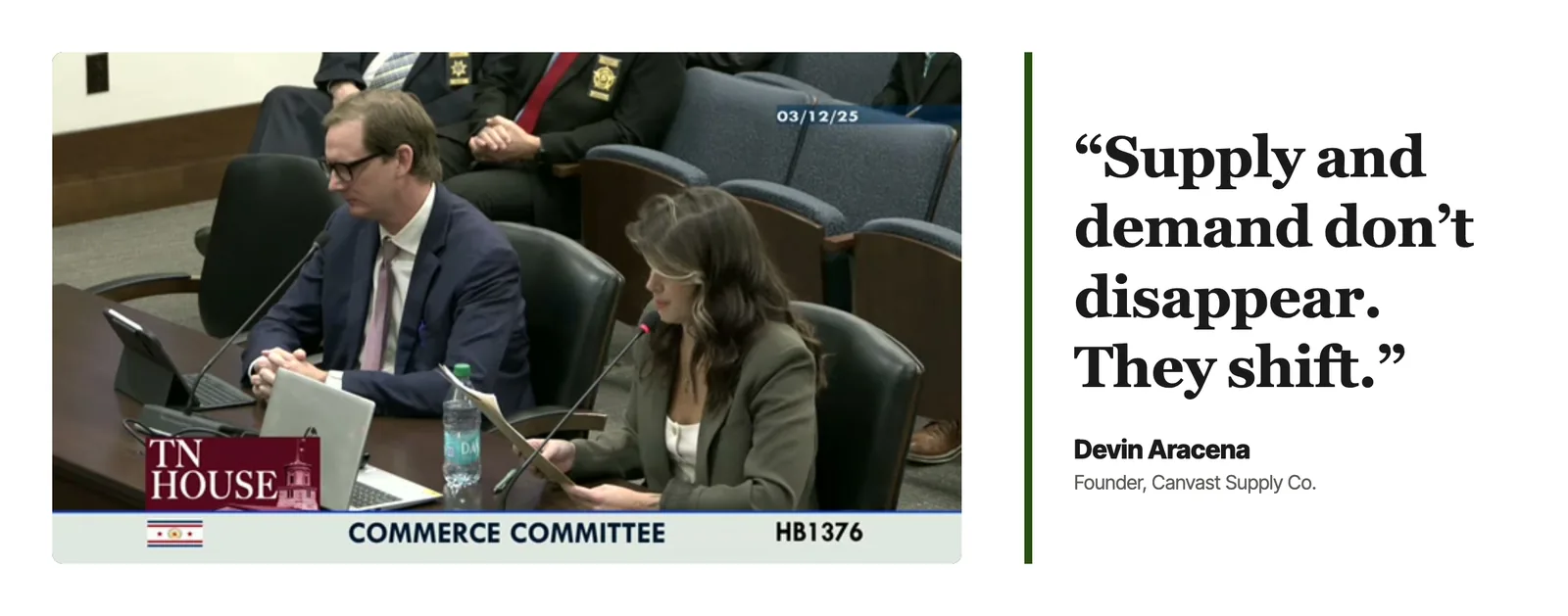
Devin Aracena, the founder of Canvast Supply Co., a Tennessee hemp supplier, told the committee that “supply and demand don’t disappear. They shift.” Restricting the products, Aracena said, “would push sales to unregulated online markets and across state lines.”
The records are public. The Department of Revenue posts its collection reports every month. The old 6% tax is listed as “Hemp-Derived Cannabinoid Collections.” The new one is listed as “Wholesale Hemp Tax.” We will keep reading them.
Shannen Sharpe is Hemp Law Group’s marketing director and a journalist who spent 11 years in broadcast news. She reported this story from the public record: legislative transcripts and session video, court filings, fiscal documents, and the Department of Revenue’s monthly collection books. Hemp Law Group’s compliance director, Clint Palmer, who appears in this story, is her colleague.