
Tennessee Banned THCa After Its Own Analysts Said It Would Cost Nothing
The THCa ban went into the bill, came out in committee, and went back in on the House floor. The state’s own analysts priced it at $0, then the budget booked $55.8 million from a market the ban shrank.
By Shannen Sharpe
This is Part 2 of a 3-part series on Tennessee’s hemp tax. Part 1 laid out the money. Part 3 covers who carries the cost.
Tennessee’s THCa ban went into the bill, came out, and went back in. A House committee removed it on March 12, 2025, after hearing from the industry. The full House put it back on April 10 from the floor, where amendments get no hearing and no witnesses, in the final 2 weeks of the session. The state’s own cost estimate, in front of the House that day, said the ban would cost nothing. The state then budgeted $55.8 million from a wholesale tax built mostly on hemp flower. The ban removed THCa flower from that market.
How the ban became law
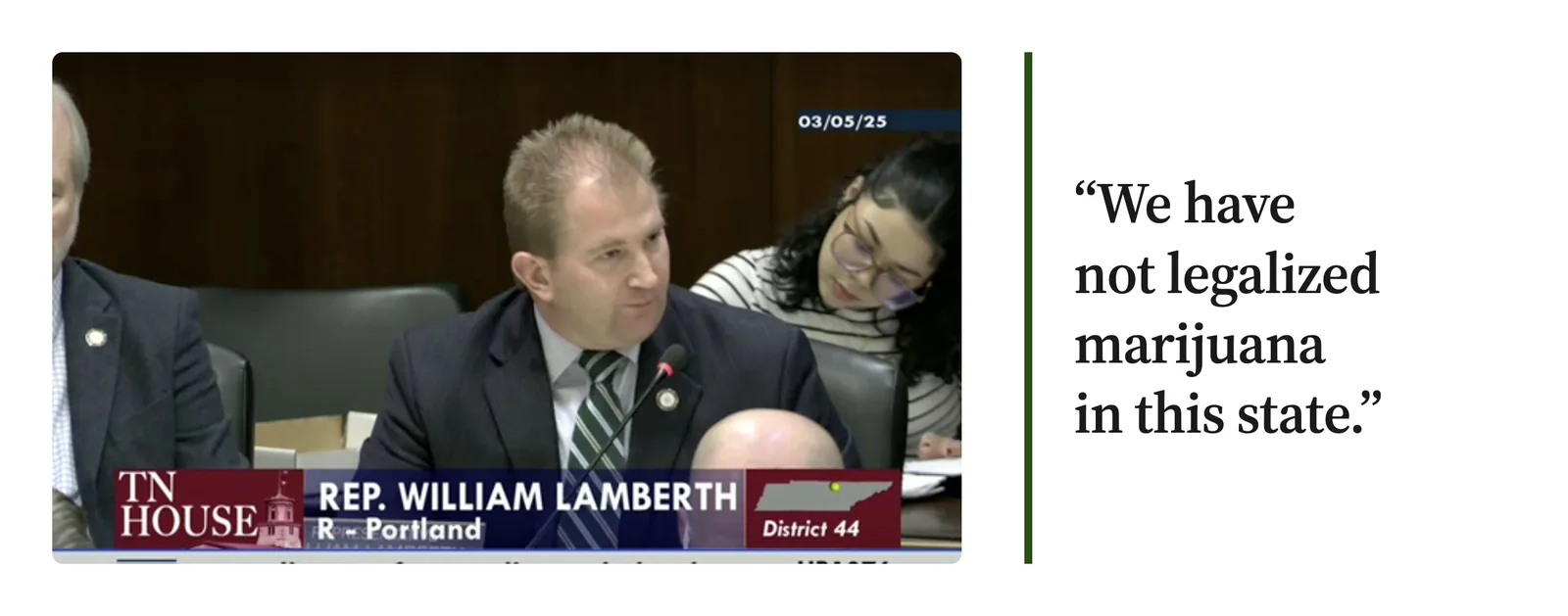
Rewind to March 5, 2025. The bill had a ban on THCa flower when it reached the House Judiciary Committee. Its sponsor, House Majority Leader William Lamberth, R-Portland, explained further.
“We have not legalized marijuana in this state,” Lamberth said. “THCa when smoked, when heated becomes marijuana, that is just what it is.”
Two years earlier, in 2023, Lamberth and Sen. Richard Briggs, R-Knoxville, had sponsored Tennessee’s first set of rules for these products. Those included licenses, a buying age of 21, lab testing with QR codes on the package, and the 6% tax. Businesses had spent 2 years building to it when the 2025 bill arrived.
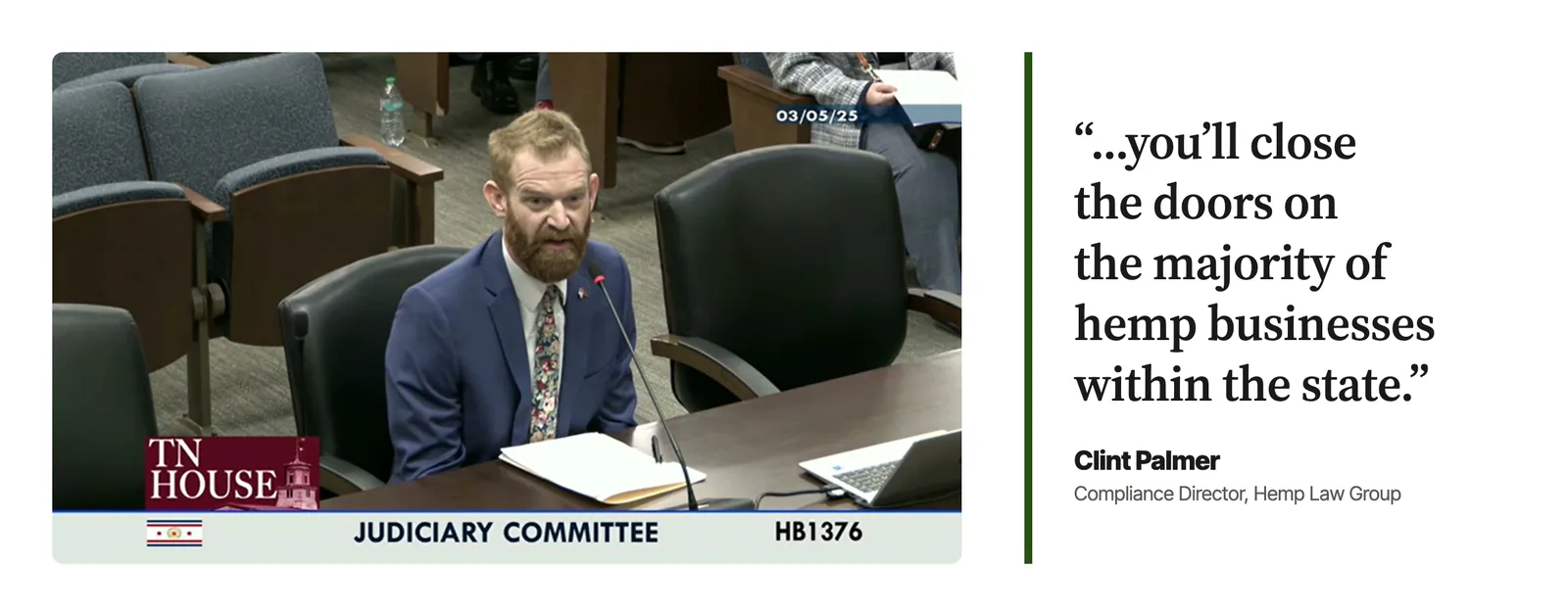
Hemp Law Group Compliance Director Clint Palmer testified against the bill, saying, “The industry has spent two years and millions of dollars shaping their businesses to comply with the 2023 bill.”
“If you pull the rug out from underneath these businesses by passing this bill, you’ll close the doors on the majority of hemp businesses within the state,” Palmer said.
Under questioning, Palmer put numbers on it. The 6% tax was bringing in “right at about $2 million a month,” he said. The stores he worked with expected to lose most of their business.
“The majority of the stores are telling me about 70% of their retail sales would be removed if this bill went through,” he said.
He also said the bill’s cost estimate did not match the tax data on the state’s own website.
“What you see on the fiscal is not actually accurate,” Palmer said.
The Judiciary Committee advanced the bill that day, 16 votes to 4. Five days later, the Fiscal Review Committee, the legislature’s office that estimates what bills will cost, issued a corrected estimate.
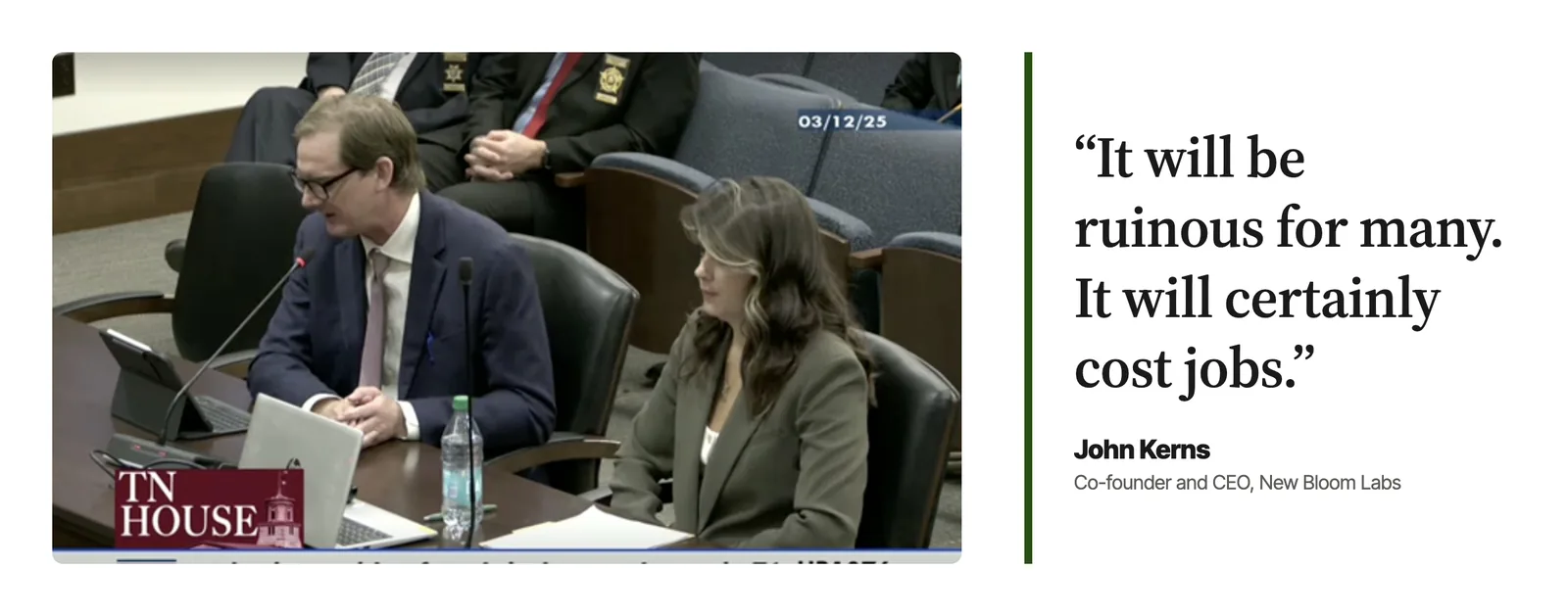
The bill reached the House Commerce Committee on March 12, 2025. Industry witnesses spoke before the vote. John Kerns, co-founder of New Bloom Labs, a DEA-registered hemp testing lab, said the industry was “comprised entirely of small businesses, including my own.” Those businesses had just finished building to the 2023 rules, he said.
“This legislation will upend all of that,” Kerns said. “It will be ruinous for many. It will certainly cost jobs.”
Lamberth had told the committee the ban was “a policy question for this committee to consider.” The committee answered. It voted 13 to 7 for an amendment that stripped the ban, carried by Rep. Jeremy Faison, R-Cosby, for the committee’s chairman, Rep. Kevin Vaughan, R-Collierville. The bill moved toward the House floor without it.
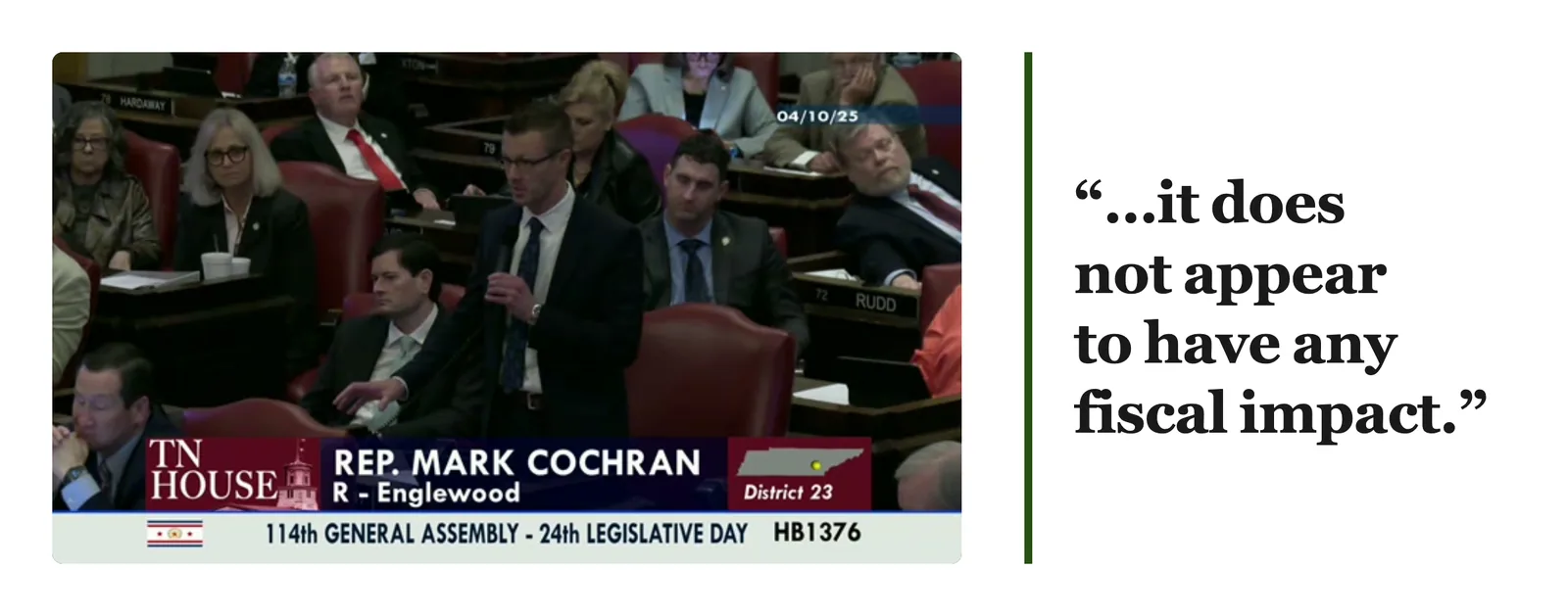
On April 10, 2025, the day of the House floor vote, Rep. Mark Cochran, R-Englewood, offered an amendment to put the ban back. The Senate’s version of the bill still had it. “They’re difficult for law enforcement to discern between that and marijuana,” Cochran said of THCa flower products. “When smoked, it is highly intoxicating.”
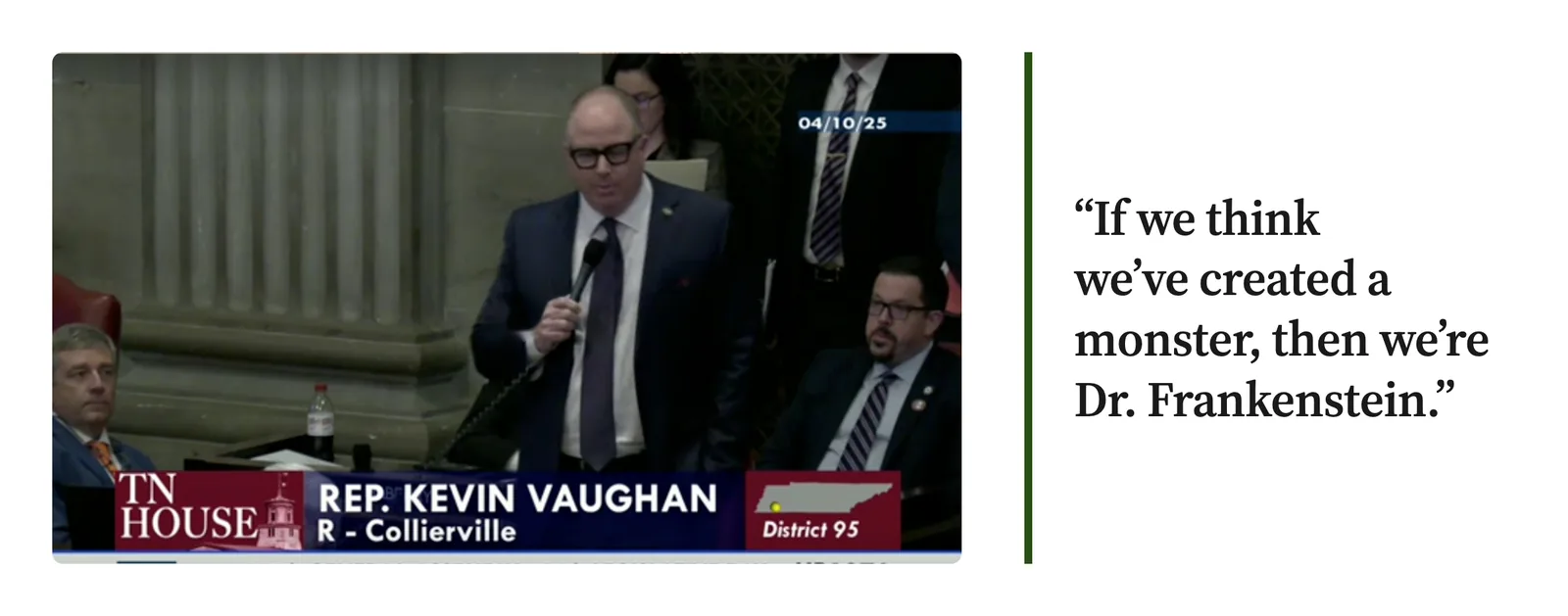
The amendment got a real debate. Vaughan, the Commerce Committee’s chairman, urged a no vote. He reminded the chamber whose word the industry had built on.
“We are the body two years ago that created this,” Vaughan said. “Let’s understand that. If we think we’ve created a monster, then we’re Dr. Frankenstein. We need to have responsibility for that.” People had made their investments, he told the chamber, “based upon our word.”
Rep. Ryan Williams, R-Cookeville, who presented the bill’s final version on the floor, said he could not support the ban without knowing what it would do to the money under the new system. He said he did not “understand the length, width and breadth of the fiscal impact” of removing those products, or what it would do to the ability of the Tennessee Alcoholic Beverage Commission, the TABC, to enforce the rest of the law.
Cochran answered that, based on the estimate for the Senate’s version, the ban “does not appear to have any fiscal impact.”
The amendment passed, 56 votes to 38.
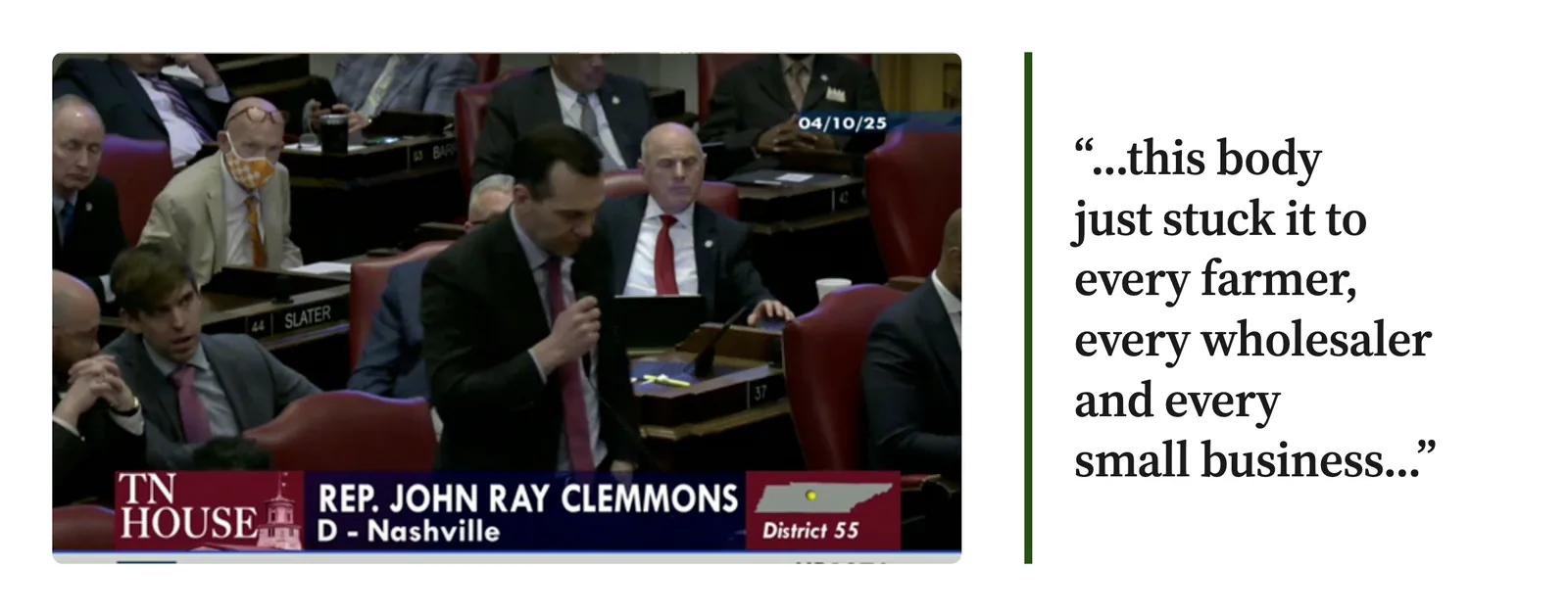
Rep. John Ray Clemmons, D-Nashville, spoke after Lamberth’s closing remarks.
“I cannot believe that this body just stuck it to every farmer, every wholesaler and every small business in the state of Tennessee that has invested in this product,” Clemmons said. “We keep pulling the rug out from one of these folks and it’s going to come back to bite us.”
The House passed the bill 69 to 21 that day. The Senate passed the House version 23 to 9 a week later.
What the state’s math said
The state’s analysts had counted the cost of a THCa ban once before. On March 10, when the bill still banned “THCa” by name, the corrected fiscal note said about 30% of hemp products contained THCa, and it subtracted the lost sales tax.
Then the bill’s wording changed. Instead of naming THCa, it set a limit on “total theoretical THC,” a formula that counts THCa as if it had already turned into delta-9 THC. Same products, different words.
The Fiscal Review Committee’s March 30 memo on the Senate’s version listed the ban, written as a 0.3% limit on total THC, as part of the bill. It put no revenue loss on it. The only product ban it counted as a loss was THCp, a different compound, in up to 3% of products. The lost sales tax had disappeared from the estimate. The memos do not say why. So when Cochran told the House the ban had no fiscal impact, he was describing the state’s estimate accurately.
On April 10, the day of the vote, the Fiscal Review Committee priced the bill again, this time with the ban in it. The revenue math did not change. It still assumed wholesalers would sell 1.2 billion milligrams of product and 1.75 million ounces of hemp flower a year. It still projected $55.8 million for the first 6 months of 2026. That is the number the state put in its budget.
What that tax has actually collected against the $55.8 million is in Part 1: about 2 cents of every dollar.
What passed
The law that passed did 4 things. It moved hemp oversight from the Department of Agriculture to the Tennessee Alcoholic Beverage Commission. It banned THCa products. It ended the 6% tax at the register. And it created a new tax paid by wholesalers, the companies that sell to stores: 2 cents per milligram of hemp-derived cannabinoid, $50 per ounce of hemp flower, and $4.40 per gallon of liquid product.
The new system is modeled on alcohol. The tax is collected from licensed wholesalers instead of at the register. That was the stated design. On the House floor, Williams said it would “all be a wholesale tax similarly to what we do for wine and spirits.” Briggs, the Senate sponsor, called it “a modified three tier system much like we do for alcohol.”
But the rules are stricter than alcohol’s. Licensed delivery services can bring alcohol to a Tennessean’s door. Hemp products must be bought face to face at a licensed store. Shipping and delivery to customers is banned.
The ban took effect Jan. 1, 2026. It did not reach the majority of stores until July 1.
How THCa stayed legal through June 30
THCa products did not leave the market on Jan. 1. Two legal fights built the runway.
The first came in December 2024, in Davidson County Chancery Court. An industry group, the Tennessee Healthy Alternatives Association, had sued the Department of Agriculture over new testing rules. The Tennessee Growers Coalition and 2 licensed hemp businesses joined the case. Hemp Law Group attorneys represented them. They challenged the department’s power over hemp flower.
On Dec. 23, 2024, the court put the rules on hold for raw hemp flower and THCa limits while it looked at the state’s testing method. The hold was first set to run to Feb. 18, 2025. The fight over the old rules continued into 2025. THCa products stayed on shelves the whole time, while lawmakers debated moving oversight to the TABC.
The second came in late 2025, in 2 steps. In October, 6 months after the House restored the ban, the TABC signed what’s called an agreed order with the industry association. It confirmed that businesses licensed by the Department of Agriculture on or before Dec. 31, 2025, stayed under the 2023 rules until those licenses expired. For that license year, that meant June 30, 2026.
In November, the association and the state’s Agriculture and Revenue departments signed a second agreed order in a separate lawsuit over the new law. It read the law the same way. The suit was dismissed. That reading now carried the signatures of both the licensing department and the taxing department. It no longer rested on one agency’s word.
The result was a 6-month window, Jan. 1 through June 30, 2026. THCa products stayed legal to sell. The tax system that had covered them was gone. The 6% tax had ended. And the new wholesale tax applies only to businesses licensed by the TABC. A business still on an old Department of Agriculture license did not owe it at all until that license expired on June 30.
So for 6 months, the businesses doing nearly all the selling sat outside the new tax. The only taxpayers in the system were a few dozen early TABC licensees. Stores spent the window selling off inventory ahead of the deadline. The state collected almost nothing on any of it.
What that runway cost the state, month by month, is in Part 1. Who carried the cost at the register, in the stores, and on the farms is in Part 3.
The records are public. The Department of Revenue posts its collection reports every month. The old 6% tax is listed as “Hemp-Derived Cannabinoid Collections.” The new one is listed as “Wholesale Hemp Tax.” We will keep reading them.
Shannen Sharpe is Hemp Law Group’s marketing director and a journalist who spent 11 years in broadcast news. She reported this story from the public record: legislative transcripts and session video, court filings, fiscal documents, and the Department of Revenue’s monthly collection books. Hemp Law Group’s compliance director, Clint Palmer, who appears in this story, is her colleague.